

Table of Contents
- Aesthetic Cat Accessories for Home Decor: A Buying Guide
- Cat-Themed Home Decor: Art, Cushions, and Figurines
- Stylish Cat Furniture: Condos, Houses, and Scratching Posts
- Modern Cat Beds and Elevated Perches
- Cat-Friendly Interior Design: Room-by-Room Styling
- Safety, Materials, and Durability: What to Check Before You Buy
- Budget Tiers and Value: What You Get at Every Price Point
- Cleaning and Maintenance for Aesthetic Cat Accessories
- Frequently Asked Questions
Last Updated: October 5, 2026
Aesthetic Cat Accessories for Home Decor: A Buying Guide
Choosing aesthetic cat accessories for home decor means balancing three things: how a piece looks, how it holds up to claws and fur, and how well it suits your cat's size and habits. This guide walks through every category, from wall art to scratching posts, with the measurements, materials, and price tiers that matter.
A ceramic figurine and a sisal scratcher live in the same room but obey different rules. One is decoration; the other is furniture your cat will destroy if it's the wrong material.
Below, we break down each category by type, with safety checks, room-by-room styling, and cleaning routines that keep everything looking sharp past the first month.
Cat-Themed Home Decor: Art, Cushions, and Figurines
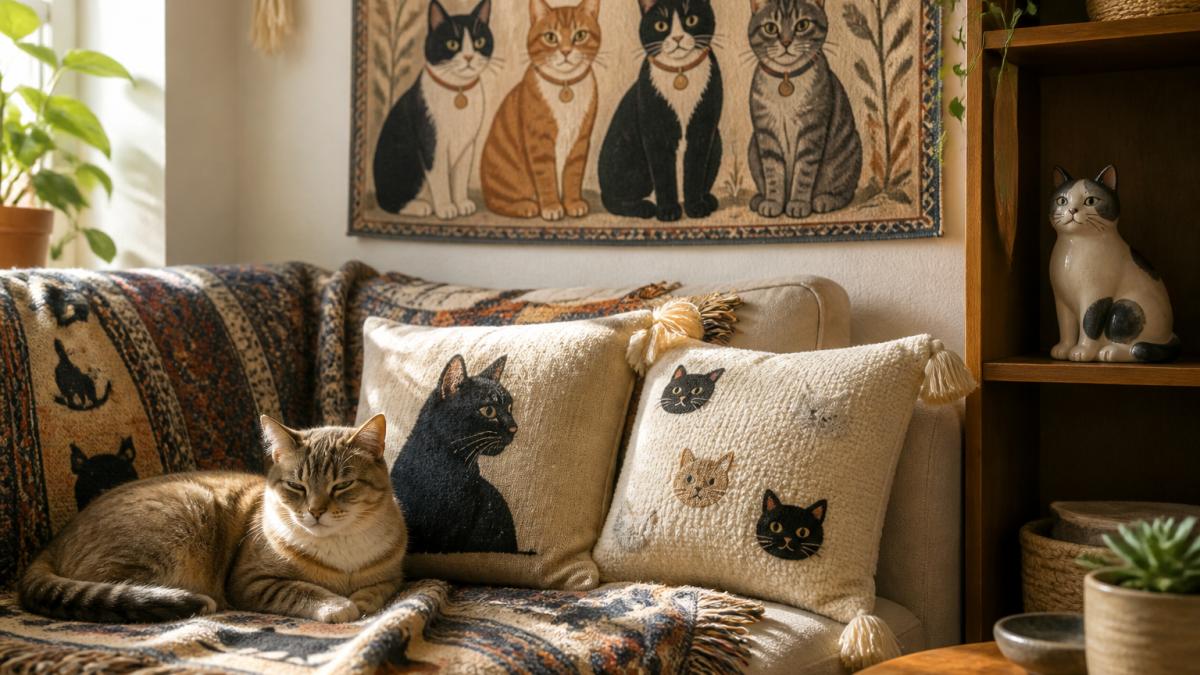
Cat-themed home decor covers the purely decorative layer of your space: wall pieces, textiles, and small objects that carry the feline motif without serving the cat directly.
Wall Art, Tapestries, and Art Prints
Wall art sets the tone for a room, and cat-themed options span vintage Japanese woodblock reproductions to minimalist line prints.
Check the material before you buy. Cotton and polyester tapestries hold color well but collect dust, so vacuum them every few weeks. Paper prints behind glass are easier to maintain but reflect glare.
Cushions, Woven Blankets, and Sofa Throws
Woven blankets and sofa throws add texture, swap easily by season, and double as a designated spot that keeps fur off your good furniture.
Cats claim soft textiles fast. To keep a throw on the sofa rather than the floor, choose a tighter weave, loose knits snag on claws within days. Cushion covers with hidden zippers survive repeated washing.
Stylish Cat Furniture: Condos, Houses, and Scratching Posts
Stylish cat furniture gives your pet what it needs without turning your living room into a pet store aisle. The category splits into two jobs, sleeping and scratching, and the best pieces do one job well rather than both poorly.
Cat Houses and Cozy Hiding Spots
A cat house or condo gives your cat a hiding spot. Cats retreat when stressed, and a covered space reduces anxiety in busy homes.
Measure before ordering. A condo that's too small gets ignored, and one that's too tall can wobble. Look for a base at least as wide as the unit is tall, and check that the cubby fits your cat's full body length with room to turn around.
Scratching Posts and Cat Scratchers
Scratching posts protect your furniture. A cat scratcher that matches your decor gets used more because you'll leave it in the room instead of hiding it.
Sisal rope and corrugated cardboard are the two standard surfaces. Sisal lasts longer and looks more like real furniture. Cardboard is cheaper and cats often prefer the texture, but it sheds and needs replacing.
Modern Cat Beds and Elevated Perches
Modern cat beds and elevated perches give cats warmth and height. A perch by a window satisfies both and keeps your cat off the kitchen counters.
Match the bed shape to your cat's sleeping style. Curlers want a donut or cave bed; stretchers want a flat mat.
Elevated perches mount to walls or windows and free up floor space, a real advantage in smaller apartments.
| Product Type | Best For | Key Check | Typical Price Tier |
|---|---|---|---|
| Wall art and prints | Small walls, renters | Frame material, glare | Budget to mid |
| Tapestry | Large blank walls | Weave density, dust | Budget to mid |
| Woven blanket | Sofa protection | Weave tightness | Budget to mid |
| Cat house or condo | Anxious cats | Base width, cubby size | Mid to high |
| Scratching post | Furniture protection | Height, surface material | Budget to mid |
| Elevated perch | Small apartments | Anchor type, weight rating | Mid to high |
Cat-Friendly Interior Design: Room-by-Room Styling
Cat-friendly interior design means placing cat items where they serve a purpose and look intentional rather than scattered. The fitting math and placement logic below make a room work for both species.
Living Room
Anchor the space with one statement piece, such as a tapestry or a sculptural scratching post, then keep accessories small and grouped:
- Scratcher placement: Put a post within arm's reach of the sofa corner your cat already targets. A post needs to be at least as tall as your cat's full upright stretch.
- Tapestry sizing: A wall hanging should span roughly two-thirds the width of the furniture below it.
- Traffic lanes: Keep at least one clear 36-inch path through the room. Cats bolt, and a perch dropped in a walkway gets knocked over.
Bedroom
Prioritize a bed your cat will actually use so it stops claiming your pillow. A cave or donut bed at the foot of your bed, or on a nightstand at pillow height, satisfies the urge to sleep near you without sharing your linens. If your cat sleeps stretched out, a flat mat at least 24 inches long gives full-body room.
2 Pack Cat Collar with Bowtie - Sushi and Donut Print →
Kitchen and Small Spaces
This is where cat-themed kitchenware earns its place on an open shelf, a kitten-shaped planter or a cat mug. In small spaces, go vertical: a wall-mounted shelf system frees floor space, but each shelf needs solid anchoring into studs.
Color Palettes That Cohere
A cohesive palette does more for a cat-friendly room than any single item. Pick two or three colors and repeat them across textiles, art, and furniture so the cat gear blends in. Three combinations that work in most homes:
- Warm neutrals: cream, oatmeal, and camel, forgiving of fur and easy to layer.
- Muted earth tones: sage, terracotta, and walnut, pairs well with wood furniture and sisal.
- High contrast: charcoal, ivory, and one accent like mustard, hides wear on high-traffic pieces.
Multi-Cat Households
For multi-cat homes, spread resources out. Two cats sharing one litter area or one perch creates friction. A common rule of thumb is one litter box per cat plus one extra, and the same duplication logic applies to perches, beds, and scratchers. Place duplicates in separate zones so no single cat can guard them all.
Safety, Materials, and Durability: What to Check Before You Buy
Safety, materials, and durability separate a purchase that lasts years from one that fails in weeks. Run through these before you buy.
- Hardware and anchors: Wall-mounted items need stud mounting or rated anchors. Test the mount with a firm downward pull before your cat does.
- Small parts: Bells, tags, and detachable bows should be secured. A loose bell is a choking hazard.
- Non-toxic finishes: Painted and stained pieces should be fully cured and labeled non-toxic. Cats groom themselves constantly and ingest whatever lands on their fur.
Budget Tiers and Value: What You Get at Every Price Point
Value in cat decor comes down to how long an item survives real use, not its sticker price. A cheap scratcher replaced three times costs more than one good one. Here's what changes as you move up the price ladder.
Budget Tier (under about $25)
Expect smaller decorative pieces and simple toys. A two-pack of cat collars with removable bowties runs $8.99, and a three-pack of catnip fish toys sits at $9.99, low-risk buys that add personality without a big commitment.

What you're giving up at this tier: thinner fabrics, particleboard instead of solid wood, and hardware that loosens over time. That's fine for a figurine. It's a problem for anything structural.
Mid Tier (roughly $25 to $150)
This is where most furniture and textiles land. You're paying for better materials and construction:
- Denser weaves on blankets and cushion covers that resist claw snags.
- Solid wood or thick plywood frames instead of particleboard, which swells and crumbles when it gets wet.
- Replaceable parts, sisal posts you can rewrap, covers you can unzip and wash.
- Rated hardware with published weight limits, so you know a perch holds a 15-pound cat.
The single best value upgrade in this tier is washability. A removable, machine-washable cover extends the life of a bed or cushion far more than a thicker fill does.
High End (roughly $150 and up)
Custom and designer pieces compete on materials and finish. The premium is justified in two cases:
- The piece is structural, a wall-mounted climbing system, a floor-to-ceiling tower, or a built-in cat shelf. Here you're paying for engineering, anchoring hardware, and a weight rating you can trust.
- It's a focal point you'll keep for years, a hand-finished wooden condo or a sculptural scratcher that doubles as decor.
The premium is not justified for decorative-only items. A ceramic figurine at $200 looks no better on a shelf than one at $30 unless you specifically want the maker or the material.
The Rule That Holds Across Every Tier
Buy the structural items well and the decorative items cheaply. A wobbly condo is a waste at any price, while a fun ceramic figurine doesn't need to be expensive to look great. When deciding whether an upgrade is worth it, ask one question: does the extra money buy a feature that affects safety, stability, or how often you'll have to replace it?
Cleaning and Maintenance for Aesthetic Cat Accessories
Cleaning and maintenance keep aesthetic cat accessories looking new, and the routine differs by material. Build these habits into your normal cleaning schedule.
- Textiles: Vacuum tapestries and blankets monthly, and wash woven throws on a gentle cycle. Air-dry to prevent shrinkage.
- Scratching posts: Vacuum loose sisal fibers and rotate cardboard scratchers so wear stays even.
- Ceramic and figurines: Dust with a dry cloth. Skip harsh sprays near anything your cat can lick.
- Collars and toys: Hand-wash collars and inspect clasps and bells for looseness each time.
Replace, don't repair, anything with a cracked surface, exposed wire, or torn seam. A damaged item near a cat is a hazard, not a bargain.
Choosing cat decor that survives a real household takes more thought than picking the prettiest item on a page. Cat Bonnet curates cat-themed apparel and pet products, from Japanese-inspired designs to everyday essentials like our quick-release collars and catnip fish toys, so you can build a space that suits your cat and your taste at once.

Frequently Asked Questions
What cat accessories look good in a living room?
Start with pieces that double as decor: a woven blanket draped over the sofa, a wall tapestry or framed art print, and a stylish cat bed that matches your color palette. A cat condo in wood or neutral fabric blends in better than bright plastic towers. Add a decorative cat figurine or two on a shelf for personality. The goal is accessories that look intentional, not like pet gear shoved into a corner.
How do I choose cat decor that is safe for cats?
Check for non-toxic finishes and avoid small parts that can be chewed off and swallowed. Collars should have a quick-release clasp, like the Cat Bonnet 2 Pack Cat Collar with Bowtie ($8.99), so your cat can escape if it gets snagged. Skip decor with loose strings, dangling beads, or breakable glass at tail height. Wash fabric items regularly and inspect stitching on toys and beds for wear.
What are some stylish cat beds and furniture options?
Modern cat beds come in felt caves, wooden-frame elevated perches, and low-profile cushions that sit flush with your furniture. For furniture, look at cat condos with clean lines, wall-mounted shelves that double as art, and scratching posts wrapped in sisal with a wood or metal base. Measure your cat's length and weight before buying, and pick materials that match your existing room palette.
How can I decorate my home with cat-themed accessories without it looking cluttered?
Pick a color story first, then choose three to five cat-themed pieces that fit it: a tapestry, a cushion, a figurine, a planter, and one piece of wall art. Group small items on a single shelf instead of spreading them across every surface. Rotate seasonal pieces rather than displaying everything at once. A cohesive cat-friendly interior design reads as curated, not crowded.