

Table of Contents
- Are Historical Cat Prints Wearable Daily? The Short Answer
- How to Style Cat Print Clothes for Everyday Wear
- Vintage Cat Print Outfit Ideas for Work and Weekends
- Cat Print Accessories That Pull an Outfit Together
- Cat Print Fabric Care: Keeping the Design Crisp
- Historical Context: Why Cat Prints Endure
- Conclusion: Wearing Cat Prints Every Day
- Frequently Asked Questions
Last Updated: October 12, 2026
Are Historical Cat Prints Wearable Daily? The Short Answer
Yes, historical cat prints are wearable daily, and they work best when you treat them as the outfit's focal point rather than its whole personality.
The key is balance.
Museum collections show that cats have appeared in art for thousands of years, from ancient Egypt to Japanese woodblock prints, so the motif carries real cultural weight.
Below, we'll show you how to wear them without looking like you raided a costume shop.
How to Style Cat Print Clothes for Everyday Wear
Start with one printed piece and build the rest of the outfit from solid colors.
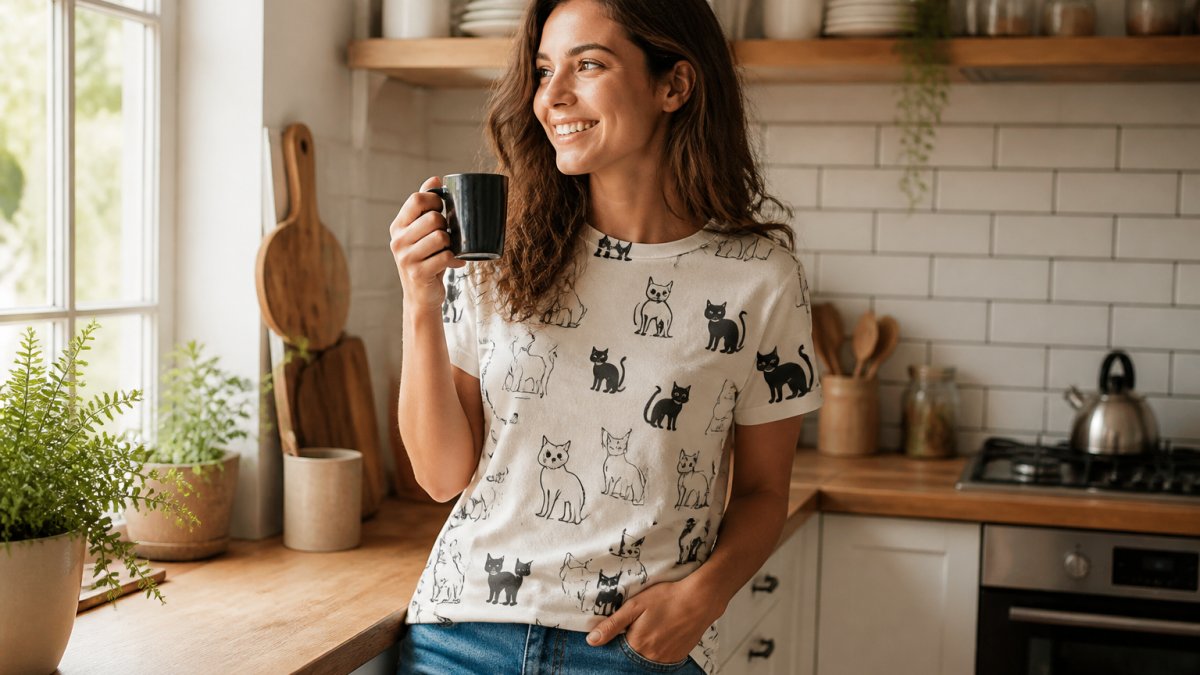
A few rules we follow when styling cat print clothes:
- Keep the print as the only pattern in the outfit
- Match the print's base color to your pants or shoes
- Add one textured layer, like a denim jacket or knit cardigan
Fit matters more than the motif. Cat Bonnet's vintage line art tees use 100% ring-spun cotton with a 6.1 oz weight, which gives the print a stable surface wash after wash.

Balancing Historical Motifs with Modern Basics
Historical cat imagery tends to be detailed linework, so it needs quiet neighbors. Pair a sketch-style cat tee with straight-leg jeans and plain sneakers. The contrast between old-world art and modern basics is what makes the look work.
If the print is busy, keep jewelry minimal. If it's a single delicate portrait, you can add a simple chain or a thin scarf.
Vintage Cat Print Outfit Ideas for Work and Weekends
For work, layer a cat print tee under a blazer and pair it with tailored trousers. The print peeks out at the collar and hem, which reads playful but still professional.

For weekends, go looser. A graphic tee, joggers, and a canvas tote cover a farmers market, a coffee run, or a bookstore afternoon.
Three outfit formulas that work:
- Office: cat print tee + navy blazer + gray trousers + loafers
- Weekend: cat print tee + straight jeans + white sneakers + denim jacket
- Evening casual: cat print tee + black jeans + leather jacket + boots
A common mistake is wearing the print head to toe. One piece carries the theme; the rest supports it.
Color Coordination for Vintage Cat Prints
Match your basics to the print's background color, not the cat itself. If the artwork sits on a washed sage or oatmeal base, build the outfit from those tones.
Garment-dyed tees make this easier because the fabric color is soft and muted rather than flat. That mellow base blends with denim, khaki, olive, and charcoal without clashing.
Cat Print Accessories That Pull an Outfit Together
Accessories let you wear the motif without committing to a full printed garment, and they are the easiest way to test whether a historical cat print fits your daily rotation before you buy a tee.

Cat print accessories work best when they repeat a color already in your outfit. A cream and black cat-print tote, for example, ties back to a black tee and cream sneakers.
Options worth trying:
- Printed bandana tied on a bag strap
- Enamel pin on a denim jacket lapel
- Cat-print socks peeking above loafers
Keep it to one or two accessories. Three competing cat items turns a styled look into a costume.
How to Choose Accessories That Survive Daily Wear
Accessories take more abuse than a tee because they get handled, rubbed against bags, and exposed to weather. A few practical filters will save you money:
- Fabric weight and weave. A canvas tote in 12 oz or heavier cotton holds its shape and resists sagging. A thin 6 oz tote will stretch and pucker within a few months of daily use.
- Print method. Screen-printed accessories last longer than heat-transfer prints, which crack and peel. On a scarf, look for a woven or jacquard design rather than a printed one if you plan to wear it often.
- Hardware. On a tote or bag, metal zippers and rivets outlast plastic. Check that the strap attachment is stitched, not glued.
- Colorfastness. Dark backgrounds on cheap accessories bleed onto light clothing. Test by rubbing a damp white cloth on a hidden area before you commit.
Accessory Care for Long Print Life
Accessories need their own routine, separate from your tees:
- Spot-clean canvas totes with a damp cloth and mild soap rather than machine washing, which can distort the shape.
- Hand-wash silk scarves in cold water with a drop of gentle detergent, then lay flat to dry away from direct sun.
- Remove enamel pins before washing the jacket they are attached to, and check the backing for rust if the pin gets wet.
- Store scarves rolled or folded flat, not hung, to avoid permanent creases in the print.
If you are new to historical cat prints, start with a single accessory, wear it for a week, and see how often you reach for it. That is the cheapest way to find out whether the motif belongs in your daily wardrobe before you invest in a full printed garment.
Teddy the Cat T-Shirt — Vintage Line Art Cat as Teddy Roosevelt →
Cat Print Fabric Care: Keeping the Design Crisp
Wash printed garments inside out in cold water, and skip the dryer when you can. Heat is what fades ink and cracks the print over time.
For heavyweight cotton tees, cold machine washing at 30C or 90F protects both the fabric and the artwork. Tumble dry on low heat if needed, and never bleach. If you iron, keep the setting low and press the reverse side, not the print itself.
A simple care routine:
- Turn the garment inside out before washing
- Use cold water and a gentle cycle
- Skip fabric softener, which can dull the print
- Hang dry or tumble on low
Historical Context: Why Cat Prints Endure
Cats have held a place in visual culture for millennia, and that long history is part of why the motif still feels fresh. But the era a print draws from changes how it reads on a body, so it helps to know what you are actually wearing.
Here is a quick field guide to the major source periods and what each one signals in an outfit:
- Ancient Egyptian (roughly 3000 BCE onward): Cats appear in tomb painting and sculpture tied to protection and the household, most famously in the form of the goddess Bastet. Prints built from this era tend to be flat, frontal, and gold-heavy. They read formal and a little ceremonial, so they work best on a scarf, a structured tote, or a single statement tee worn with dark, tailored basics.
- Medieval European manuscripts (roughly 1100-1500): Illuminated books and bestiaries are full of cats, sometimes drawn as themselves and sometimes as moral lessons. The look is cramped, inky, and hand-drawn. This is the era that produced the paw prints you may have seen in old books, where a real cat walked across wet ink and left a mark that survived for centuries. Prints from this source read quirky and academic, which pairs well with denim, corduroy, and knitwear.
- Japanese woodblock prints (Edo period, 1603-1868): Ukiyo-e artists gave the cat a graphic, outlined, high-contrast treatment that still shapes modern design. The palette is often indigo, vermilion, and cream. These prints read clean and modern, so they sit comfortably on a tee with straight-leg jeans or a plain overshirt.
- Victorian cat portraiture (roughly 1837-1901): This is the era of sentimental cat paintings and the earliest cat photography, when cats moved from working animals to household companions in popular imagery. Prints from this source read soft, nostalgic, and slightly fussy, which suits a blouse, a cardigan, or a framed-print-style graphic on a relaxed tee.
That range matters for styling. A Japanese-inspired print reads graphic and modern. A Victorian-style portrait reads soft and nostalgic. Knowing which era your print draws from helps you match it to the right outfit and occasion.
How to Tell a Historical Reproduction from a Modern Mashup
This is the part most guides skip, and it is the difference between wearing a piece that looks intentional and wearing one that looks like a novelty shirt.
A true reproduction starts from a specific, identifiable source: a named artwork, a dated manuscript page, or a documented print. A modern mashup borrows the look of an old era but invents the composition, mixes periods, or adds elements that never appeared together.
Signs you are looking at a genuine reproduction or a faithful period-inspired design:
- The artwork is credited to a source, even if only as "after [artist]" or "Edo-period woodblock."
- The palette matches the era. Egyptian work leans ochre, lapis, and gold; Edo work leans indigo and vermilion; Victorian work leans sepia and muted rose.
- The linework matches the medium. Manuscript cats have uneven, hand-inked edges. Woodblock cats have crisp outlines and flat color blocks. A print with smooth digital gradients is almost certainly modern.
- The composition is not centered and symmetrical in a way that old work rarely was. Historical images were often cropped, off-balance, or part of a larger page.
Signs you are looking at a modern mashup:
- The cat is wearing sunglasses, a crown, or a hoodie that did not exist in the source era.
- Two eras are blended, such as an Egyptian cat rendered in a woodblock style.
- The print is described only as "vintage" or "retro" with no period named.
Neither category is wrong to wear. But if the goal is to wear a historical cat print daily and have it read as art rather than merch, a faithful reproduction or a clearly period-inspired design will hold up better over time and start better conversations.
Wearing Historical Motifs Respectfully
A few of these images carry real cultural meaning. Egyptian cat imagery is tied to religious practice, and Edo-period cat prints sit inside a specific artistic tradition.
A simple rule: if you can name the era and the source, you can wear it with confidence.
For deeper context, the Metropolitan Museum of Art's collection of works featuring cats is a good place to see how the imagery evolved across these periods.
Conclusion: Wearing Cat Prints Every Day
The real challenge is not whether historical cat prints are wearable daily.
At Cat Bonnet, we build our tees for exactly that. Our vintage line art designs use 100% ring-spun cotton with a heavyweight 6.1 oz feel, garment-dyed for a soft, lived-in look.
Get started with Cat Bonnet and find a cat print you will actually reach for every week.
Frequently Asked Questions
Are historical cat prints suitable for everyday outfits?
Yes, historical cat prints work for daily wear when the garment is built for comfort. Look for soft, durable fabrics like ring-spun cotton and prints that sit on the chest or as an all-over pattern. A relaxed-fit tee with a hand-drawn cat illustration pairs easily with jeans, chinos, or a skirt, making it a practical choice for errands, casual Fridays, or weekend outings.
How can you style cat-print clothing without making an outfit feel costume-like?
Keep the rest of your outfit simple. Let the cat print be the focal point and balance it with neutral pieces like solid denim, black trousers, or a plain cardigan. Avoid combining multiple novelty items in one look. For example, a vintage cat print tee under a blazer and tailored pants reads as smart-casual rather than themed.
What clothing colors work well with vintage-inspired cat prints?
Neutral tones like cream, charcoal, navy, and olive create a calm backdrop that lets the print stand out. If the print has warm hues, try earth tones; for cooler prints, go with grays and blues. Garment-dyed tees in muted colors offer a soft, lived-in look that pairs naturally with vintage cat imagery.
How do you care for printed clothing so the design lasts?
Turn the garment inside out before washing, use cold water, and avoid bleach. Tumble dry on low heat or hang to dry. Iron on low heat, never directly on the print. Following these steps keeps the ink from fading and the fabric soft, so your cat print fabric care routine extends the life of the design.