

Table of Contents
- Why Most Cat Apparel Fails (And What to Check First)
- The Best Fabric for Cat Themed Shirts: Weight, Fiber, and Feel
- Signs of Poor Quality Clothing: A 7-Point Inspection
- How to Wash Cat Apparel to Prevent Fading
- Fabric Toxicity and Chemical Safety in Printed Tees
- Fit, Sizing, and Range of Motion for Real Bodies
- Boutique vs. Mass-Produced: How to Tell the Difference
- Conclusion: Your 30-Second Quality Checklist
- Frequently Asked Questions
Last Updated: October 4, 2026
Why Most Cat Apparel Fails (And What to Check First)
Most cat apparel disappoints because shoppers judge design, not construction. Spotting high quality cat apparel comes down to four checks: fabric weight, seam quality, ink type, and fit. Skip one and you get a shirt that fades, twists, or falls apart.
- Fabric weight. Thin cotton shows every flaw fast.
- Seams and hems. Weak stitching means a short life.
- Print method. Cheap inks crack. Good inks stay put.
- Fit across the shoulders. A tight shirt pulls at the seams.
The American Apparel and Footwear Association's fiber and care labeling guidance treats clear fiber content and care labeling as basic consumer information, which is exactly why the tag matters more than the photo.
Below, we break down each check, plus a 30-second version for the store aisle.
The Best Fabric for Cat Themed Shirts: Weight, Fiber, and Feel
The best fabric for cat themed shirts is mid-to-heavyweight ring-spun cotton, usually around 6.1 oz. That weight holds its shape, hides print flaws, and feels soft; lighter fabric shows wear much faster.
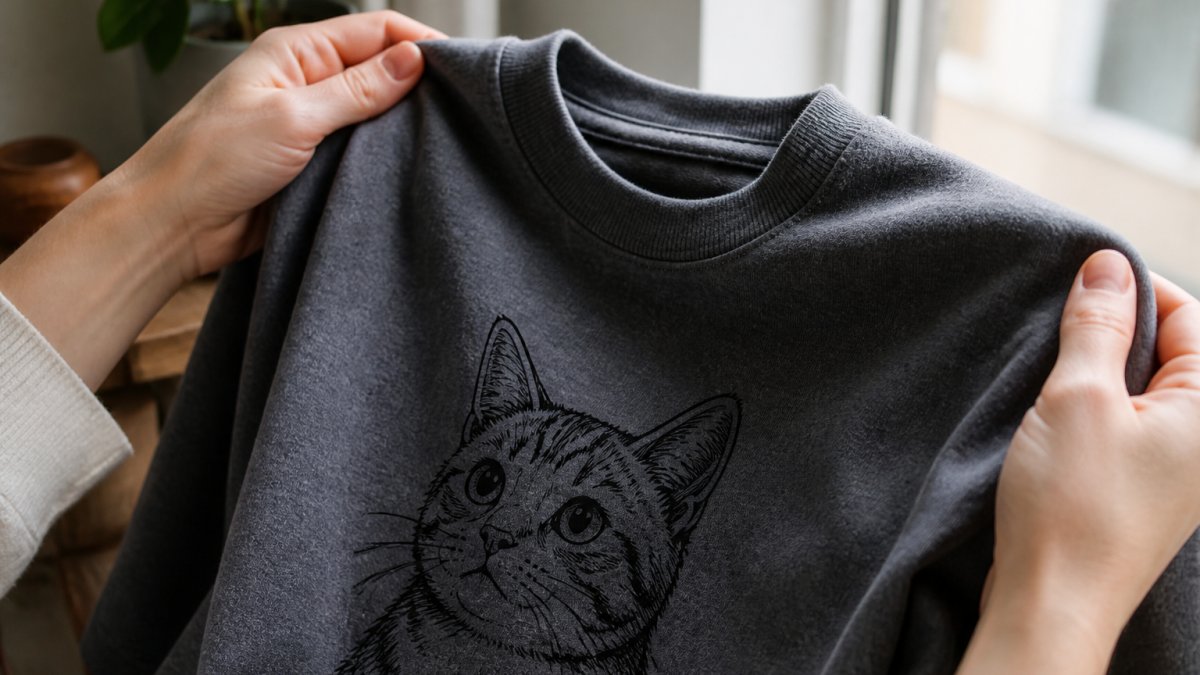
Fiber content decides how a shirt ages. Natural fibers like cotton breathe well and soften over time. Synthetic blends resist wrinkles but trap heat.
Cotton Weight and Why 6.1 oz Matters
Fabric weight is measured in ounces per square yard. A 6.1 oz cotton tee drapes instead of clinging and survives repeated washing without turning see-through; thin 4 oz shirts stretch at the neck within a month.
Ring-Spun vs. Open-End Cotton
Ring-spun cotton spins fibers tighter for a smoother, stronger yarn. Open-end cotton is cheaper but rougher and pills sooner, if the fabric feels fuzzy or coarse, it's likely open-end.
Why Cat Owners Should Care About What's In the Fabric
Most guides stop at weight and weave, missing what matters most when a cat wears the shirt.
Fiber Choice and Grooming Behavior
Smooth, tightly spun cotton slides against the coat and resists snagging on a cat's tongue. Loosely knit or brushed fabrics catch on the tongue's papillae, encouraging chewing and fiber ingestion. Test it: rub the fabric against the back of your hand the way a cat would lick it. If fibers pill immediately, the cat's tongue will do the same.
What to Ask Before You Buy
- What ink chemistry is used, and is it water-based?
If a seller can't answer these, treat the garment as unverified.
Signs of Poor Quality Clothing: A 7-Point Inspection
The clearest signs of poor quality clothing show up in the details, not the design. Check seven points:
- Stitch density. Fewer than 8 stitches per inch is a warning sign.
- Seam type. Look for double-needle stitching, not single.
- Hem width. A narrow, flimsy hem curls after washing.
- Print edges. Sharp, clean lines mean a better ink process.
- Neckline ribbing. Thin ribbing stretches out fast.
- Side seams. Tubular knits have no side seams, so there's less to twist.
- Label type. A sewn-in label outlasts a printed one.
If three or more fail, walk away, one flaw can be a fluke, three is a pattern.
Seam Integrity and Stitch Density
Seam integrity is the best predictor of how long a garment lasts. Pull the side seam apart; visible gaps between stitches mean it will split under normal wear.
Print Durability: Water-Based vs. Plastisol Inks
Water-based inks soak into fabric, so the print feels soft and moves with the shirt. Plastisol inks sit on top as a rubbery layer that cracks along fold lines. Press a fingernail into the print: if it's raised and stiff, expect cracking.
How to Wash Cat Apparel to Prevent Fading
Washing cat apparel inside out in cold water is the fastest way to prevent fading. Heat is the enemy of dye and print; cold water and low heat keep a good shirt looking new for years.
Follow these habits:
- Turn the shirt inside out before washing
- Wash in cold water, max 90F
- Skip bleach entirely
- Tumble dry on low, or hang dry
- Iron on low, and never directly on the print
Colorfastness depends on the dye, but heat speeds fading in every case. Uneven fading usually means too much heat, too often.
Fabric Toxicity and Chemical Safety in Printed Tees
Printed tees can carry chemical residue from dyes and inks, so check what went into the print.
Ask two questions:
- What kind of ink was used?
- Is the print done in-house or outsourced?
In-house printing gives a maker far more control over ink choice. That's why we print our own designs in-house with eco-friendly, permanent water-based inks, slower, but we know exactly what touches the fabric. If a seller can't tell you what ink they use, that's your answer.
Rock & Roll Guitar Cat - Men's Tee →
Fit, Sizing, and Range of Motion for Real Bodies
A well-made cat garment fits across the shoulders and chest without pulling at the seams, and lets the cat move, stretch, and groom as if it were wearing nothing.
Here's how to get it right:
- Compare those numbers to the maker's own chart, not a generic one
- Check the return policy before you order
Ergonomic Design: How the Garment Affects Movement and Grooming
A well-designed cat garment has a gusseted or raglan-style armhole, a slightly shorter back length than a dog garment of the same chest size, and a tail opening that sits at the base of the tail rather than over it.
Hardware Safety: Buttons, Zippers, Snaps, and D-rings
Hardware is the most overlooked safety issue in cat apparel. Anything a cat can reach with its mouth is a potential choking or obstruction hazard.
- Buttons. A cat can bite a button off in seconds. If a button is used, it should be a shank-style button sewn with heavy thread and reinforced with a backing button on the inside.
- Zippers. Metal zipper pulls are a chew target. Look for a zipper with a covered pull or a fabric garage that hides the teeth from the cat's mouth.
- Snaps. Plastic snaps crack and leave sharp edges. Metal snaps can pinch the skin. Prefer hook-and-loop closures that release under light tension.
- D-rings and leash attachments. If the garment has a D-ring for a leash, it should be attached to a reinforced webbing strap, not sewn directly to the fabric. A D-ring that pulls free under load is a real risk.
- Decorative beads, bells, and rhinestones. These are the highest-risk items. A cat can pull them off and swallow them. Avoid them entirely on any garment a cat will wear unsupervised.
Stress-Free Dressing: Introducing Clothing Without Anxiety
A stressed cat won't wear a garment well, no matter how well it's made. The introduction matters as much as the construction.
A common pattern that works:
- Leave the garment in the cat's space for a day so it picks up the cat's scent.
- Let the cat sniff and rub against it with no attempt to put it on.
- Place the garment on the cat's back for a few seconds, then remove it and reward.
- Increase wear time in short sessions, one minute at a time.
- Only fasten the closures once the cat is relaxed with the garment resting on its back.
Watch for stress signals: flattened ears, dilated pupils, a tucked tail, freezing, or frantic attempts to remove the garment. If you see them, back up a step, forcing it creates a negative association that's hard to undo.
Range of Motion Test
If any of these fail, the garment is the wrong size or cut, regardless of what the label says.
| Check | What Good Looks Like | What to Avoid |
|---|---|---|
| Chest fit | Snug but two fingers slide under | Tight enough to leave marks |
| Armholes | Gusseted or raglan, free shoulder rotation | Straight sleeve, binding |
| Back length | Shorter than a dog garment of same chest size | Covers the tail base |
| Hardware | Covered zipper, reinforced D-ring, hook-and-loop | Loose buttons, beads, bells |
| Movement | Normal gait, full stretch, grooming reach | Stiff walk, frozen posture |
Our women's tanks run slightly smaller than standard, so we tell customers to double-check the chart and size up.
Boutique vs. Mass-Produced: How to Tell the Difference
Boutique pieces usually print in small batches; mass-produced items trade that control for volume. Neither is automatically better, but the differences are checkable.
Look for these signals:
- Small batch runs. Designs sell out and restock slowly.
- Named printing. The seller says where and how it's printed.
- Real customer photos. Not just studio shots.
- Honest sizing notes. Warnings about running small.
- Clear returns. A seller who stands behind the product.
Federal Trade Commission guidance on textile and wool labeling requires accurate fiber content and country of origin on textile products, so a legitimate seller will always show that information.
Our Rock & Roll Guitar Cat men's tee is a good example: printed on American Apparel or Bella Canvas blanks, hand printed with permanent water-based ink, and ships free with returns and exchanges. The Teddy the Cat tee uses 100% ring-spun US cotton at 6.1 oz with double-needle stitched seams, a pre-shrunk finish, and a sewn-in label.

Conclusion: Your 30-Second Quality Checklist
Run this before you buy:
- Fabric weight is 6.1 oz or heavier
- Seams use double-needle stitching
- Print is water-based and soft to the touch
- Fiber content and care label are visible
- Sizing chart is specific to the maker
- Return policy is clear
Six checks, thirty seconds. Most cat apparel on the market skips half of them: thin blanks, plastisol prints, vague sizing, no returns. You deserve better than a shirt that quits after five washes. At Cat Bonnet, we print on heavyweight ring-spun cotton, use permanent water-based inks, and offer free returns and exchanges so you can order with confidence. Browse our collection and find a piece that holds up as well as it looks.
Frequently Asked Questions
What is the 3-3-3 rule for clothes?
The 3-3-3 rule for clothing suggests a garment should last at least three years, survive at least 30 washes without visible fading or seam failure, and be worn at least three times per month to justify its cost. For cat apparel, apply the same logic: check whether the print holds up after 30 cold washes, whether seams stay intact, and whether you actually reach for it regularly. A $35 tee worn weekly for three years costs pennies per wear.
What are the signs of high-quality fabric in cat-themed apparel?
Look for a fabric weight of at least 6.1 oz (heavyweight), ring-spun cotton rather than open-end cotton, and a pre-shrunk or garment-dyed finish. High-quality cat apparel also uses double-needle stitching at the hems and neckline and feels dense but soft when you pinch it. If light passes through the fabric easily when held up, it is too thin to last.
How can you tell if a graphic print on a shirt will last?
Press your thumb firmly on the printed area and pull gently. If the ink feels like a raised plastic layer that cracks or peels at the edges, it is plastisol and will degrade faster. Water-based inks, which are common in eco-friendly US-printed shirts, soak into the cotton fibers and feel almost flush with the fabric. These prints survive more washes without cracking.
How do you distinguish between mass-produced and boutique cat apparel?
Boutique cat apparel usually has a sewn-in label rather than a printed neck tag, uses garment-dyed or hand-printed processes, and often ships from a specific print shop you can verify. Checking the care label for fiber content and origin is also a quick filter.